So what exactly is an atom?
Imagine a tiny solar system. At the center, a compact nucleus made of protons and neutrons. Around it orbit electrons, like planets around a sun.
Stability and fission
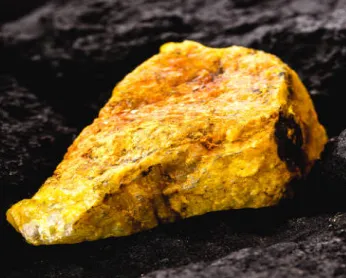
This nucleus is generally stable, but some elements like uranium 235 are less so. A single neutron can be enough to destabilize it.
When that happens, the nucleus splits into two smaller parts, releasing an immense amount of heat and light: that is the process of nuclear fission.
Glossary key terms
See the definitionsA chain reaction
When a uranium nucleus breaks apart, it releases not only energy but also new neutrons. These will strike other nuclei, which in turn split.
The domino effect
This cycle repeats endlessly: that is what we call a chain reaction. You can compare it to a row of dominoes: as soon as the first falls, everything follows.
But here, each "fall" releases gigantic energy on the atomic scale. This principle makes fission both powerful and hard to control.

From atom to electricity
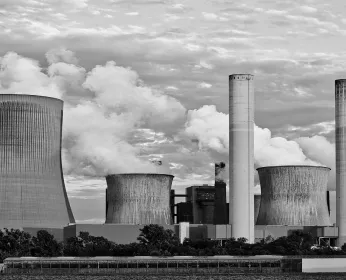
In a nuclear power plant, the energy released by fission turns into heat. That heat boils water, whose steam spins turbines to produce electricity.
Fission, first a laboratory phenomenon, has become one of the pillars of our modern world.
Fission between progress and responsibility
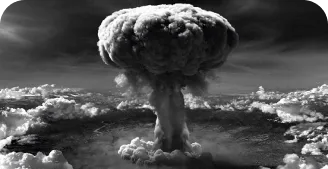
This reaction, capable of lighting up entire cities, also led to the creation of the atomic bomb.
Lise Meitner, who provided its theoretical explanation, refused to take part, convinced that science should enlighten, not destroy.
This moral dilemma still runs through our time: how can we reconcile knowledge and responsibility?
"Scientists bear a responsibility for what they discover."
From science to collective story
Nuclear fission not only transformed physics: it also marked our collective imagination. A symbol of power and fear, it still inspires literature and cinema, between fascination and unease.
That is the case of the documentary Atomic Power, which questions how science sometimes becomes a storytelling tool, between promise and threat.